If you're getting divorced in Tennessee, you'll hear about the "60-day waiting period" early on. It's the one part of an uncontested divorce that nobody can speed up, so it helps to know exactly how it works.
This guide explains when the clock starts, what happens while you wait, and how to make sure your 60 days start as soon as possible.
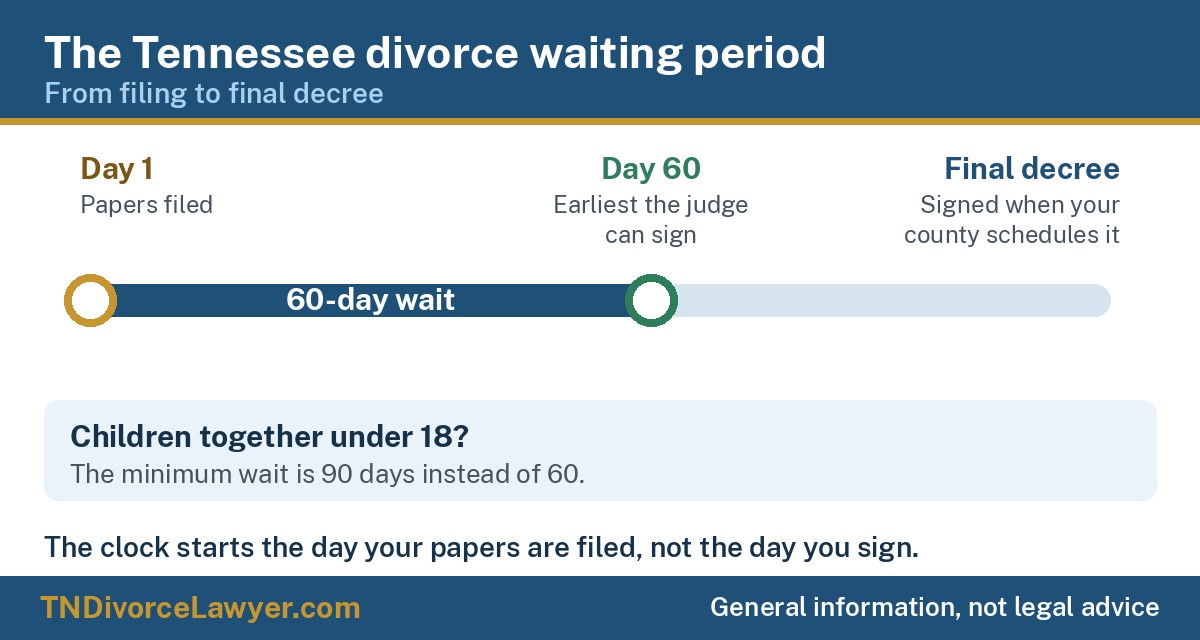
The short answer: Tennessee law says a divorce on the ground of irreconcilable differences can't be granted until the papers have been on file with the court for at least 60 days. If you and your spouse have children together who are under 18, the wait is 90 days. The clock starts on the day your papers are filed, not the day you decide to divorce.
What is the Tennessee divorce waiting period?
The waiting period is a minimum amount of time the law requires between filing for divorce and the judge signing the final decree. It applies to divorces on the ground of irreconcilable differences, Tennessee's no-fault ground, which is how nearly every uncontested divorce is filed.
| Your situation | Minimum wait after filing |
|---|---|
| No children together under 18 | 60 days |
| Children together under 18 | 90 days |
The waiting period is a floor, not a deadline. The judge can sign your decree any time after it ends, and when that happens depends on your county's schedule.
When does the 60-day clock start?
The clock starts on the day your divorce papers are filed with the court clerk. It doesn't start when you and your spouse decide to divorce, when you sign the papers, or when you mail them.
That's why getting the papers prepared, signed and filed quickly matters so much. Every week the papers sit on a kitchen counter waiting for a signature is a week added to your divorce.
Can the waiting period be waived or shortened?
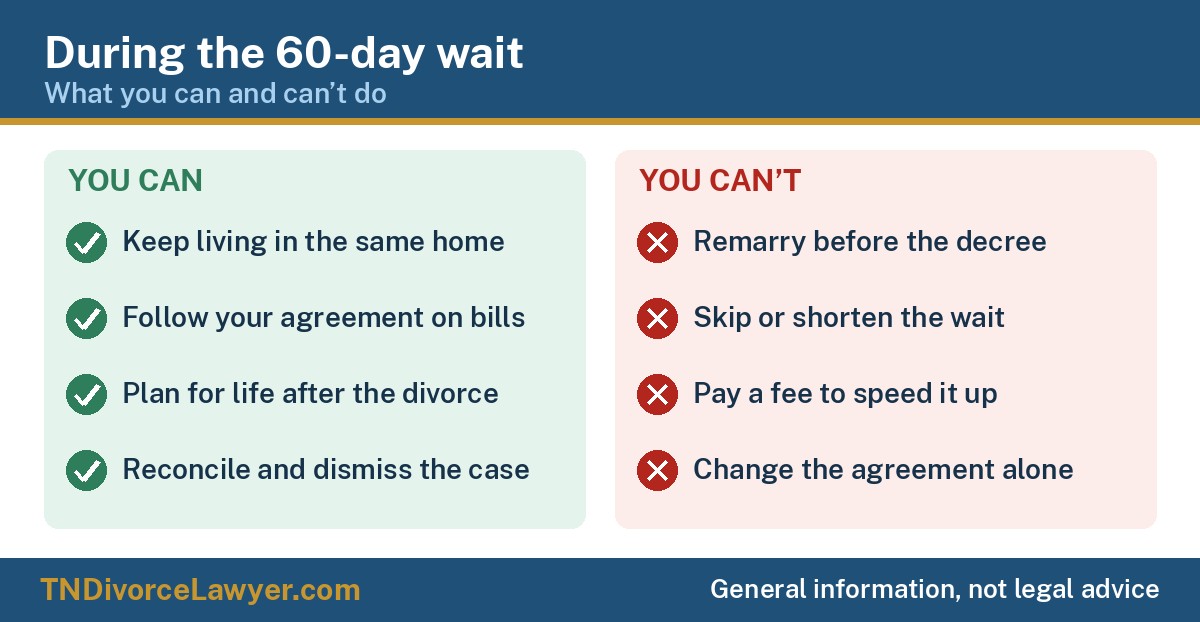
No. The judge can't sign the final decree before the waiting period ends, even if you and your spouse agree on everything and both want it done sooner. There's no fee you can pay or form you can file to skip it.
What you can control is everything around the 60 days: how quickly your papers are filed, and whether they're right the first time.
What happens during the waiting period?
For most couples without children, nothing. You don't have to go to court or file anything else while you wait. The time simply has to pass.
A few things are good to know:
- You're still legally married. Until the judge signs the Final Decree of Divorce, you can't remarry.
- You don't have to live apart. Tennessee doesn't require you to be separated before or during the waiting period for an irreconcilable differences divorce.
- Keep to your agreement. If your agreement says who pays which bills, start following it so there are no surprises later.
- Either of you can still change your mind. If you reconcile, the case can be dismissed. If one spouse stops agreeing before the decree is signed, the case can't finish as an uncontested divorce.

How to use your 60 days
In an uncontested divorce, you and your spouse already worked out who gets what before you filed. The waiting period is a good time to get ready to put that agreement into action once the divorce is final:
- Plan when to separate your finances. Decide when you'll open accounts in your own name and move direct deposits and automatic payments, so you're ready the day the decree is signed.
- Review your beneficiaries. Life insurance, retirement accounts and bank accounts often name a spouse. Make a note of what you'll update once the divorce is final.
- Get ready to update your name. If your decree will restore a former or maiden name, make a list of where you'll need to change it, like Social Security, your driver's license and your bank.
- Set up your own budget. Living on one income takes planning, so start tracking what you'll need.
- Keep copies of everything. Hold on to your signed agreement and any paperwork from the court.
What can restart the clock?
The 60 days are counted from the day the complaint is filed. When people fill out and file the papers on their own and the court sends them back for a missing form or the wrong county, the papers have to be filed again, and the clock starts over from the new filing date. Other mistakes, like an agreement the judge won't approve, can add weeks and mean another trip to the courthouse.
With our Full Service Package, a licensed Tennessee attorney prepares your papers and files them with the court, so your 60 days start right away and you never have to go to court.
When is the divorce final?
Your divorce is final when the judge signs the Final Decree of Divorce, which can happen any time after the waiting period ends. Until then, you're still married. Once you have the decree, get a certified copy for your records. You'll need it to change your name, retitle vehicles or the house, and update beneficiaries. For the full picture, see how long a divorce takes in Tennessee.
Start your 60 days sooner
With our online uncontested divorce service, you answer the questions in our online interview whenever it suits you. A licensed Tennessee attorney prepares your papers from your answers and files them with the court for you, and once the judge signs your decree, the attorney mails it to you. Our service is for couples who agree on everything and don't have children together who are under 18. If your situation is different, you can request a free consultation with a Tennessee divorce attorney.
The bottom line
Tennessee's divorce waiting period is 60 days from filing, or 90 days if you have children together who are under 18. You can't skip it, but you can make sure it starts as soon as possible and doesn't start over.
Ready to get your 60 days started? See if you qualify in about a minute, or read how to get an uncontested divorce in Tennessee, step by step.
Sources: Tennessee Code Annotated § 36-4-101 (grounds for divorce) and § 36-4-103 (irreconcilable differences, waiting periods and marital dissolution agreements).